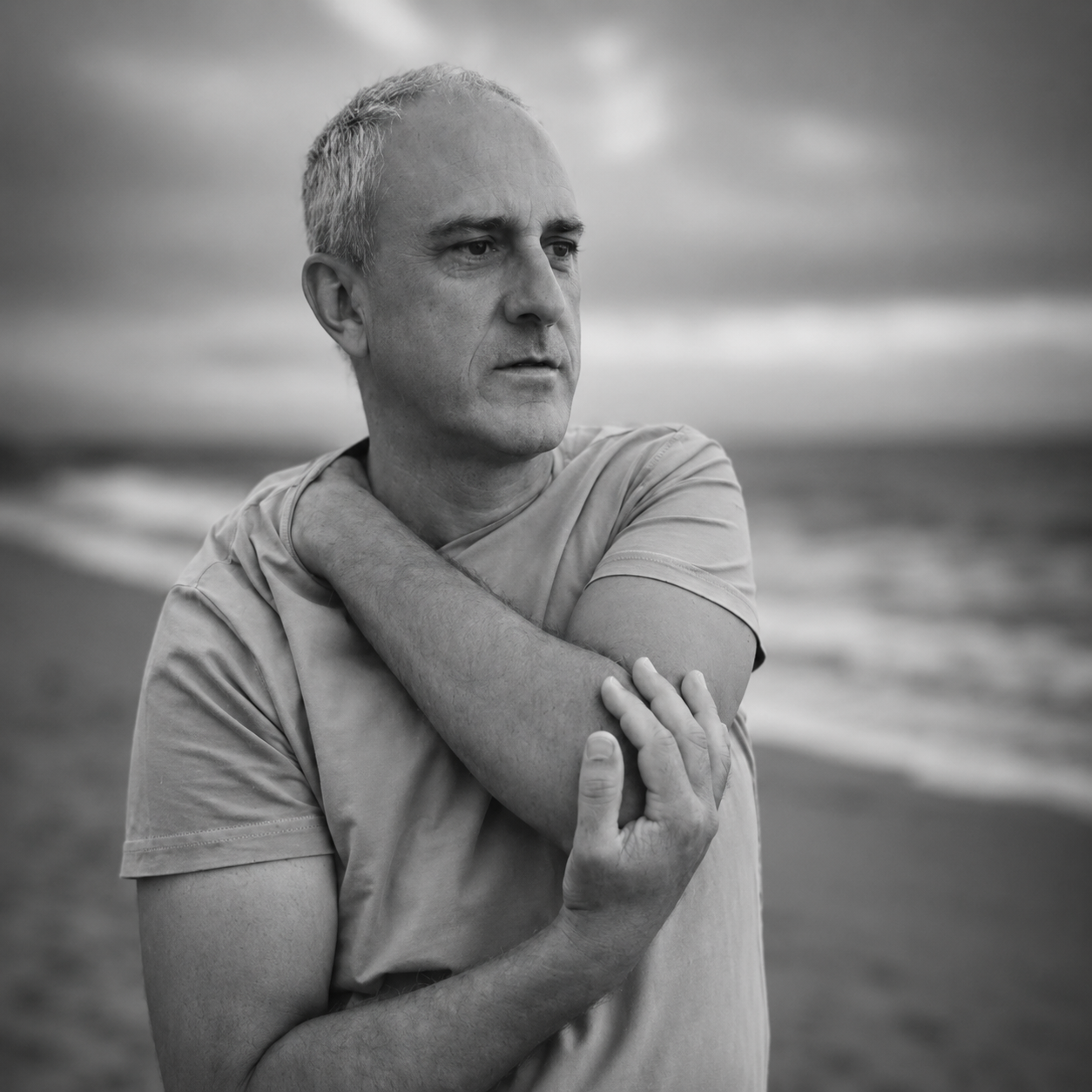
Giulio Rugarli
Giulio Rugarli
Evolutionary Counselor · Member of the Keep On Evolving collective.
Bio
I was born in Italy in 1965. My mother died when I was eleven, with no warning that it was coming. It taught me early what the Buddhist traditions call anitya — that everything here is impermanent. Accepting that took years. Long before I accepted it, it had already become the fuel for the only question I have really followed since: what is on the other side of the veil?
At twenty-four, already deep in Eastern philosophy and in the study of psychic phenomena, I left for California to study transpersonal psychology — the part of the field that takes the spiritual dimension of a life seriously rather than explaining it away. I graduated from USC in Los Angeles in 1993.
Near the end of my studies I signed up for a workshop by Dr. Roger Walsh, expecting Buddhism and shamanism. What he introduced me to instead was A Course in Miracles. It answered the question my mother's death had opened: that death is an illusion, as much as physical reality is. My life reordered itself around that, and through it I came to the channeled material as well — in person first, then through books and recordings.
Three further years of academic training gave me the title of Holistic Counselor. Since then I have spent the better part of two decades in the room where psychology stops asking and spirituality starts answering — working with people who arrived with a problem and discovered, underneath it, a much older question.
What I draw on is collected in our library: the patient redefinitions of forgiveness, the physics of belief, the descent into the parts of ourselves we have been told to hide. The teachings are tools; the work is ours.
Approach
Most of what people call a "problem" is the surface of a much older question. My work is to help us find the real question, sit with it long enough to recognise it, and then act from what we find.
Sessions are conversations, not protocols, and genuine experiences. We meet weekly, and people typically stay as long as they need to overcome any difficulties. I do not like to see myself as a teacher but as a companion on a journey no one else can make for you.
The Traditions I Draw From
The three traditions below are the wells I drink from. They are not three versions of one thing, and none of us needs all three: different people find their way in through different doors. Each has its own landing page, and each opens a studying path through its key concepts — introduced through my own encounter with them, not as encyclopedia entries.
A Course in Miracles (ACIM) — scribed by Helen Schucman
A Course in Miracles is not a religion but a curriculum, and it means the word literally: a text, a workbook of 365 daily lessons, and a manual for teachers. What it sets out to dismantle is the architecture of fear, and it teaches that every moment presents the same choice — between the illusions of the ego and the quiet truth of love. It does not ask us to escape the world, but to look upon it with new eyes through the practice of true forgiveness: releasing grievances, recognizing our shared innocence, undoing the belief that we are separate from our source or one another. A miracle, in the Course's own definition, is nothing more than that — the shift from judgment to grace.
I found A Course in Miracles in 1992, through the work of Dr. Roger Walsh. It introduced me to the transpersonal dimension of existence — the part of us that is not our biography — and it reordered my life. What has stayed is the Course's own word for what we are here to do: function. Not a career, not a destiny. Forgiveness, practiced daily, and nothing grander than that.
→ Read the studying path through A Course in Miracles
Bashar — channeled by Darryl Anka
Channeled through Darryl Anka for over forty years, Bashar is a multidimensional being whose message strips away spiritual mysticism to reveal something far more empowering: the mechanics of how reality actually works. Rather than asking for belief or devotion, Bashar presents existence as a flawless mirror — one that never judges, but simply reflects our state of being, energy, and deepest definitions back to us. Acting on our highest excitement, to the best of our ability, with zero insistence on a specific outcome — that is the whole instruction. Following it is how we find the creative power that was ours all along.
I met Bashar in 2009. What has stayed with me since is the claim that happiness is not a result. It does not wait on circumstances, and it does not have to be earned — it is a state we are free to choose for no reason other than wanting it. Everything else, the mirror takes care of.
→ Read the studying path through Bashar's teachings
Pathwork — Eva Pierrakos
Pathwork is not a bypass around human struggle but an intentional descent into it — a transformative path uniting psychological rigor with spiritual realization. Rather than condemning our defenses, it offers the tools to unmask the hidden misconceptions and protective layers that divide us from life: what Pathwork calls the Mask, the agreeable self we present in place of the one we are afraid of. When we meet the pain of that Lower Self with radical honesty and self-responsibility, old contractions dissolve, frozen life energy is liberated, and we are re-anchored in the fearless truth and creative wisdom of the Higher Self.
Pathwork came to me in 2013, during my counseling training, and I trusted it for an unusual reason: it promised me nothing pleasant. It does not sell a quick fix and it does not flatter — it says, plainly, that evolving means finding the courage to look at the parts of ourselves we least want to see. A teaching that warns us the work will be uncomfortable is not recruiting followers. It is trusting us to want the truth more than comfort.
→ Read the studying path through Pathwork
Practice
If you'd like to work with me directly, the Practice page describes how I work with clients and the formats I offer. The first session is 45 minutes, free, and carries no commitment on either side — its only purpose is for both of us to see whether this is the right work, with the right person, at the right time.
Writing
I write about these traditions and the practice that flows from them. The blog collects shorter pieces — observations, walkthroughs, letters to skeptics, occasional dialogues.